The Superintelligence Podcast
Europe’s AI sovereignty problem

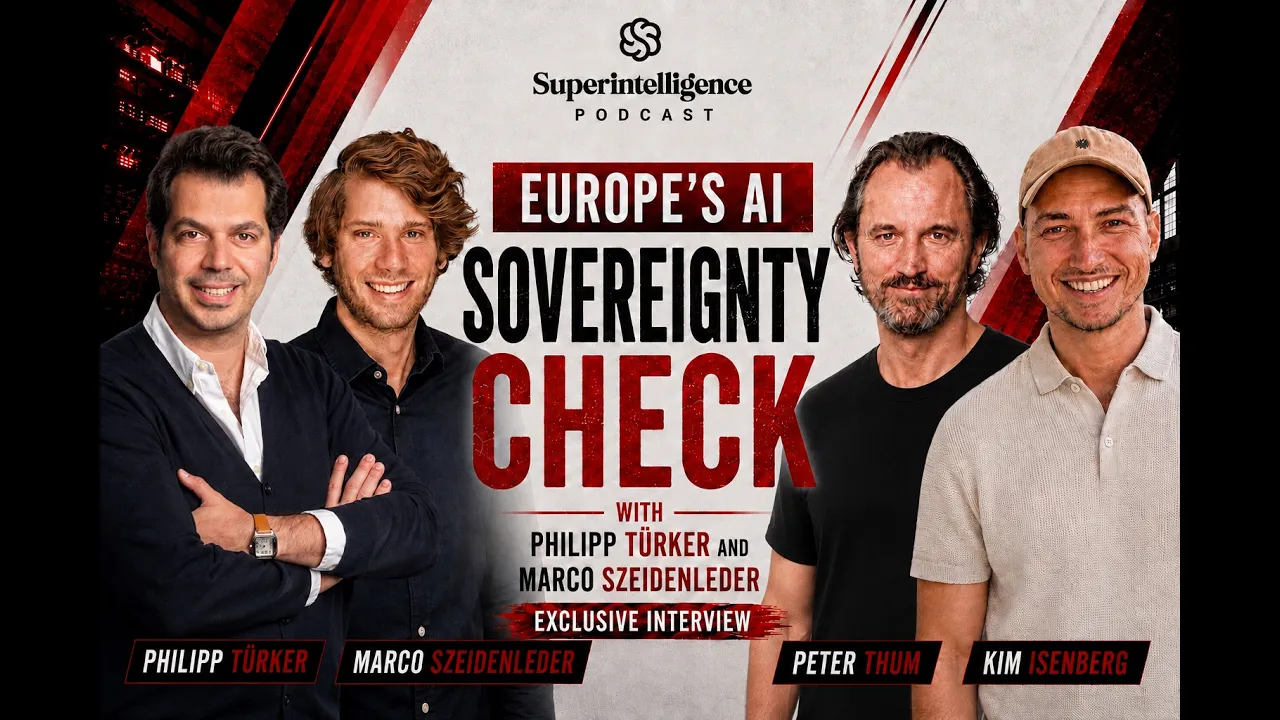
Philipp Türker & Marco Szeidenleder
Co-founders, PandaOS

“The true litmus test is: are you capable of switching your inference on a random Tuesday without it breaking your operations and without affecting your client base?”
In this conversation
Does running an American AI model in a European data center make it sovereign? PandaOS co-founders Philipp Türker and Marco Szeidenleder join Kim Isenberg and Peter Thum on The Superintelligence Podcast to discuss who controls the models, data and infrastructure. Türker calls a US provider with a European postcode “window dressing” and argues that sovereignty means being able to switch providers without operations breaking. Szeidenleder compares companies to a logistics firm that does not need to build its own engine, only to make sure nobody can switch it off midway, and describes large German companies defaulting to a cut-down Microsoft Copilot. The founders explain why PandaOS is desktop-first and why they see sovereignty as a scale rather than an on and off switch, made visible through what the software does and which permissions it requests. The conversation also covers the EU Inc. framework, specialized European models, and spreading AI across providers like a stock portfolio.
Key takeaways
Model usage is commoditizing, Türker argues. What was true for Opus six months ago is true for an open source model today.
A European postcode on a US provider does not make it sovereign, Türker says, because the Cloud Act can still reach into that environment.
Ninety-nine percent of companies do not need on-premise AI setups, the founders say. Only niches such as highly sensitive IP or government contracts do.
PandaOS is desktop-first. For database work it can send only the schema to the model and run the resulting SQL on the user’s device, without the model reading the raw data.
Companies should first build a data infrastructure they own, so they can move to another provider at any point, Szeidenleder advises.
More interviews
The daily AI briefing people actually read.
What shipped, who’s winning, and what it means. Six days a week, in under ten minutes.
Interested in a partnership?