The Superintelligence Podcast
Inside NVIDIA Cosmos

Ming-Yu Liu
Vice President of Research, NVIDIA

“In Cosmos, we want to build the Matrix for robots, not for humans.”
In this conversation
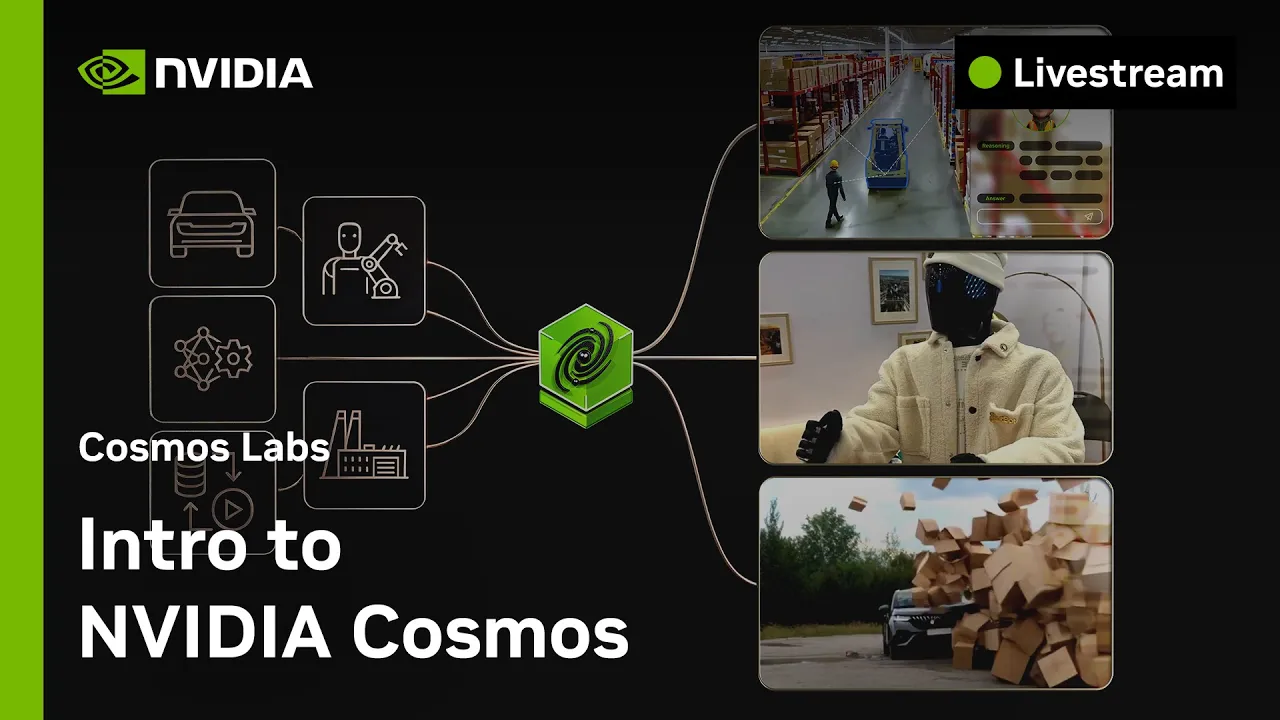
How can robots and self-driving cars learn skills before they reach the real world? In this Cosmos Labs livestream, Kim Isenberg talks with Ming-Yu Liu, Vice President of Research at NVIDIA, about NVIDIA Cosmos, its open world foundation model for physical AI. Liu compares Cosmos to The Matrix: a dream world, configurable to each robot’s sensors, where machines train before release. He walks through its main models: Cosmos Predict generates future video from images, prompts or robot actions, Cosmos Transfer makes simulator output look real and varies recorded demonstrations, and Cosmos Reason judges whether a task was completed. He explains why Cosmos Policy builds on a video model rather than a language model and why open weights matter for researchers. The conversation, with community questions, also covers lessons from developers, why humanoid robots are harder than self-driving cars, and his benchmark for a breakthrough: replacing 90% of data acquisition with compute in some workflows.
Key takeaways
Cosmos has three main models: Predict generates future video from an image plus a text prompt or robot actions, Transfer makes simulator output look realistic, and Reason checks whether a robot completed its task.
Physical AI may need even more training data than language models, because the visual world is richer than language, Liu says.
Both the source code and the model weights of Cosmos are open, so developers can adapt it to robots with different camera setups or lidar.
Cosmos learns physics implicitly from training data rather than enforcing physical laws as hard constraints. Simulator data from Isaac is used to bias it toward physical correctness.
A real breakthrough would be replacing 90% of the data acquisition in some workflows with compute, Liu says.
More interviews
The daily AI briefing people actually read.
What shipped, who’s winning, and what it means. Six days a week, in under ten minutes.
Interested in a partnership?