The Superintelligence Podcast
How AI agents will change work

Mick Costigan
VP, Salesforce Futures

“There is no profession in history that has been transformed as fast as coding.”
In this conversation
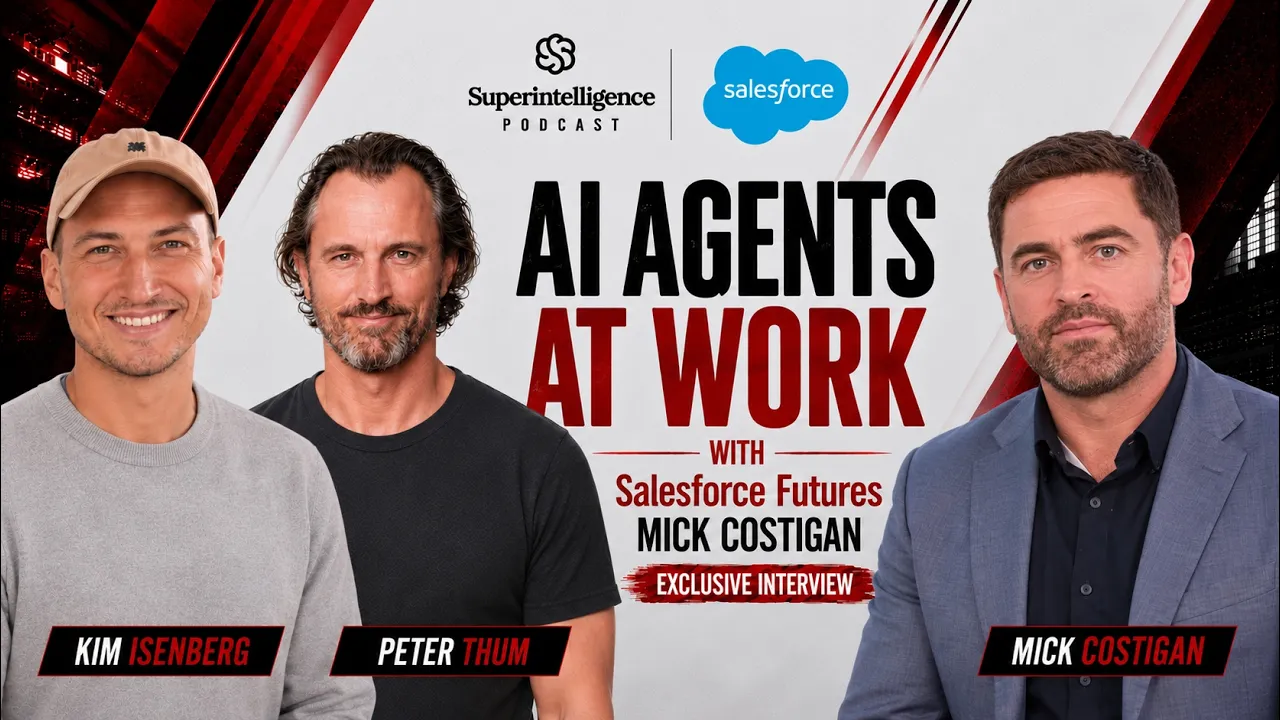
Which parts of your job can an AI agent take over, and how do you check its work? Mick Costigan, VP of Salesforce Futures, joins Kim Isenberg and Peter Thum on The Superintelligence Podcast at Dreamforce to talk about AI agents, education and the future of work. Costigan compares early LLMs to the tiny engine of Carl Benz’s 1886 Motorwagen, mounted on bicycle wheels and a garden bench; only now is the rest of the vehicle, from the trust layer to context engineering, being built. He calls the current moment a “phony war” that ends when faster companies start to gain a real competitive advantage. On education, he warns about students who get answers without doing the work and expects critical thinking to remain a mark of human intelligence. The conversation also covers business models for personal AI assistants, when companies should build agents rather than buy them, and digital twins that let businesses test strategy before acting on it.
Key takeaways
Coders at big tech companies told Costigan that in nine months it has reached the point where nobody on their teams writes more than 10% of the code.
Costigan sorts work by how verifiable it is and how much data models have about it. Work that is hard to verify and has little data is where human judgment and taste will persist.
The next frontier is organizational harnesses that bring a company’s intent and context to agents, not just personal harnesses, Costigan argues.
Nine of the top ten AI companies in the world run on Slack, according to Costigan.
Apple has a trust advantage in personal AI assistants but also an antitrust problem, Costigan says.
More interviews
The daily AI briefing people actually read.
What shipped, who’s winning, and what it means. Six days a week, in under ten minutes.
Interested in a partnership?