The Superintelligence Podcast
Why NVIDIA gives away its best models

Kari Briski
VP of AI, NVIDIA

“There’s no one model to rule them all. We believe in a global ecosystem of open models and proprietary models too.”
In this conversation
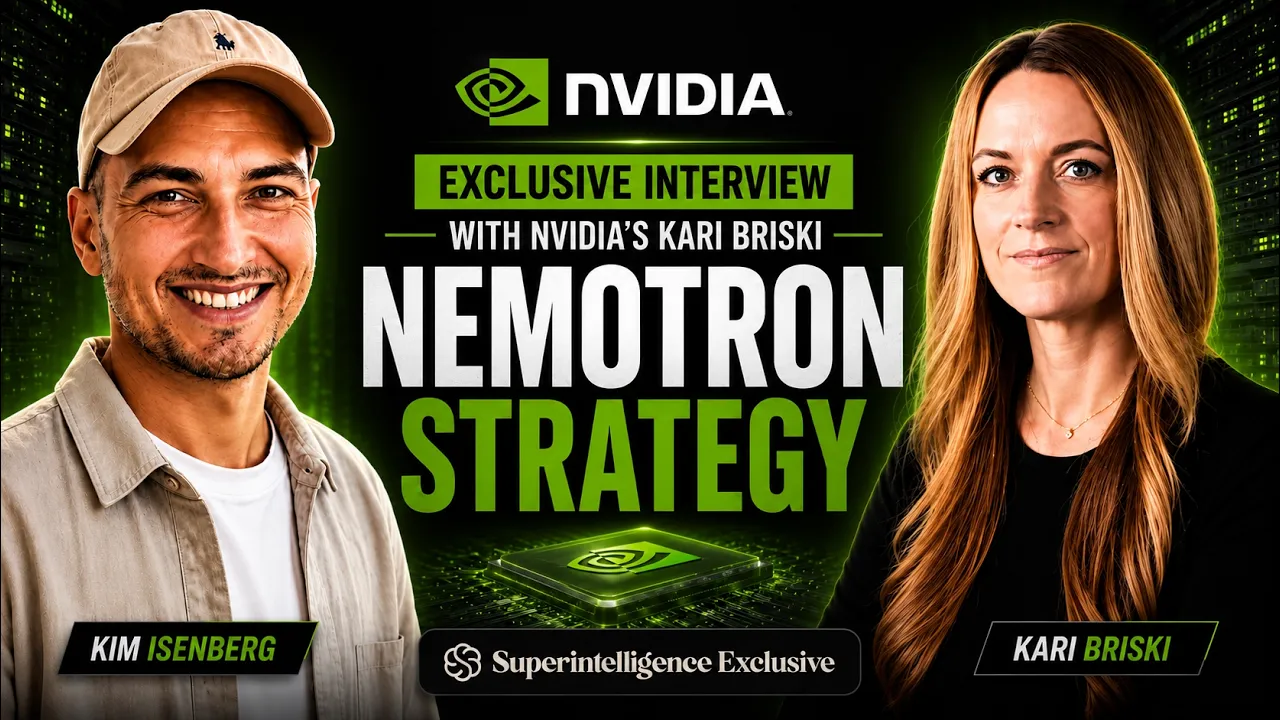
Why does NVIDIA publish its best models along with the recipe for training them? Kari Briski, VP of AI at NVIDIA, joins Kim Isenberg at GTC 2026 on The Superintelligence Podcast to discuss Nemotron 3 Super. Briski explains the hybrid Mamba-Transformer architecture, why NVIDIA trained in NVFP4 precision from the start, and how predicting several tokens at once speeds the model up by about 3.5x in practice. She also explains why NVIDIA releases its training recipes, datasets and environments, which most open-weight labs keep private. The conversation also covers the Nemotron Coalition with Mistral AI and the Ultra base model.
Key takeaways
Nemotron 3 Super has 120 billion parameters but, as a mixture of experts model, responds like a 12 billion parameter model. The point is speed, Briski says.
NVIDIA trained Super in NVFP4 reduced precision from the start to show that this can reach state-of-the-art accuracy, and published the recipe.
Predicting multiple tokens at once gives a speedup of around 5x in theory and about 3.5x in practice, depending on the use case.
NVIDIA releases its training data and post-training environments, which most open-weight labs keep private. Its business does not depend on the model and it has no consumer endpoint, Briski says.
The Ultra base model finished training a week before the GTC keynote and is now in post-training. Briski calls it the best open base model in its size category.
More interviews
The daily AI briefing people actually read.
What shipped, who’s winning, and what it means. Six days a week, in under ten minutes.
Interested in a partnership?