The Superintelligence Podcast
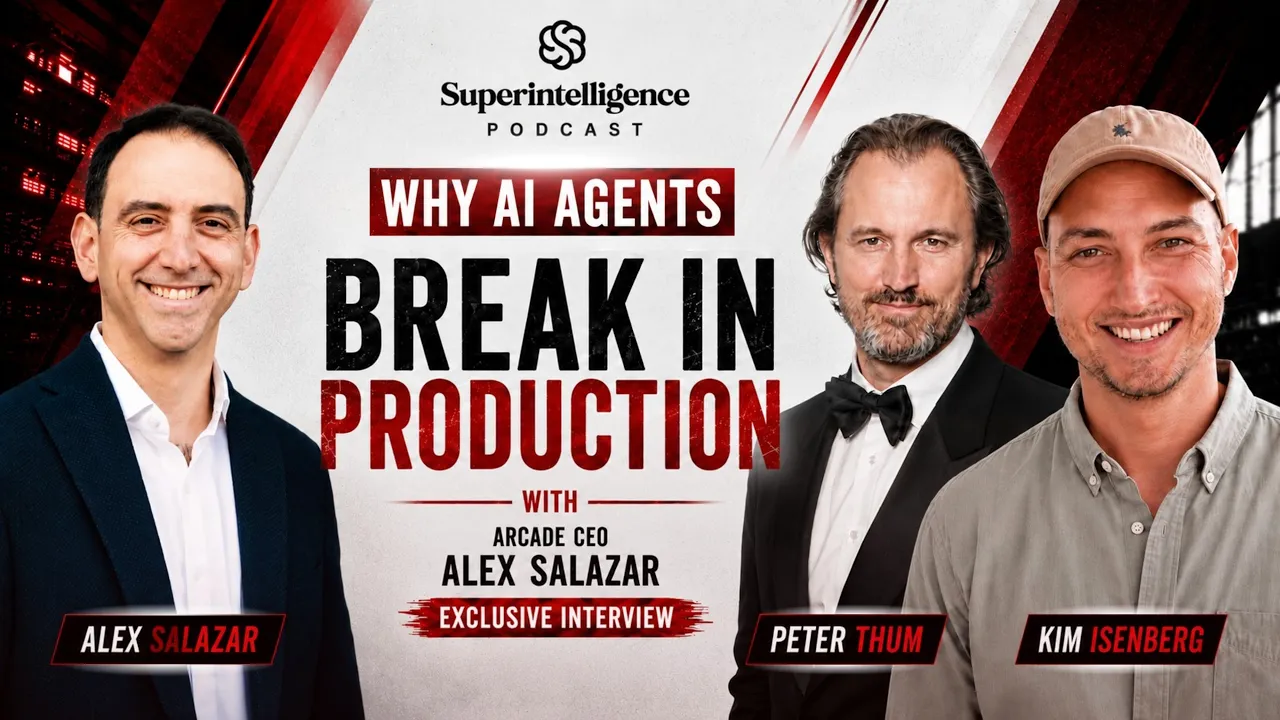
Why AI agents break in production

Alex Salazar
Co-founder and CEO, Arcade

“When you look at AI agents, authorization is the problem because you can’t trust the agent to enforce its own policies.”
In this conversation
AI agents can reach almost any business system, but who decides what they are allowed to do, and how does a company prove they followed its rules? Alex Salazar, co-founder and CEO of Arcade and formerly VP of Product at Okta, joins Kim Isenberg and Peter Thum on The Superintelligence Podcast to discuss enterprise agents. Salazar explains why access control cannot live inside the agent and must sit where it acts: an agent can hallucinate about robbing a bank, he says, and nobody cares until it walks into the bank. He separates guardrails, which shape a model’s character, from governance, which limits what it can touch, since even a well-raised child does not get access to your bank account. The conversation also covers why good MCP servers are built around user intentions rather than raw APIs, who takes the blame when an agent makes a mistake, and why Salazar expects service accounts for agents to fall out of favor.
Key takeaways
An agent should only act where both the agent and the user it works for have permission, Salazar says. If either lacks access, the operation fails.
Salazar names three common failure patterns: giving the agent its own service identity, giving it the user’s full identity, and requesting all permissions at login instead of least privilege access.
Every request an agent makes goes through Arcade and is reauthorized, and the agent never holds the keys itself.
Arcade wrote the MCP specification for tool-based authorization, officially called URL-based elicitation, with support from AWS, Okta and Microsoft.
Arcade sees few autonomous agents at customers. Most deployments are a human operator driving an agent directly.
More interviews
The daily AI briefing people actually read.
What shipped, who’s winning, and what it means. Six days a week, in under ten minutes.
Interested in a partnership?